Noticias · Six Senses· (English original)
Six Senses Transforms London Landmark: Biophilia Meets Grandeur at The Whiteley
London's historic Whiteley department store now houses the UK's debut Six Senses, fusing original grandeur with a biophilic vision. AvroKO's design reimagines retail psychology to cultivate wellness.
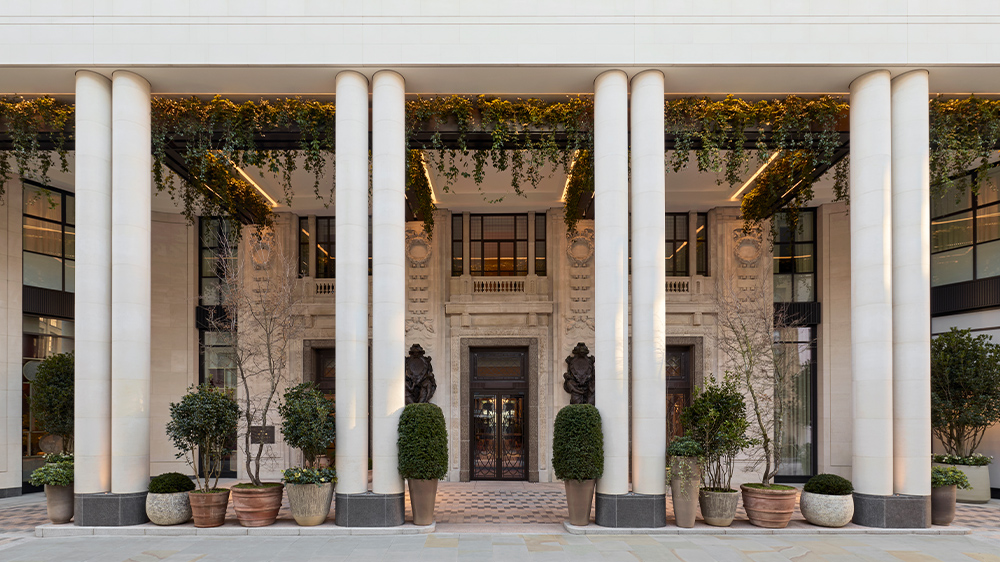
A grand hotel lobby with a restored original marble staircase and a green-and-white checkerboard floor.
Announced July 21, 2026, Six Senses has established its first UK outpost, launching at The Whiteley, a historic London department store that originally opened in 1911. This marks not only the brand's British debut but also the introduction of its inaugural Six Senses Place members' club.
The Whiteley's founder, William Whiteley, was inspired by the Great Exhibition of 1851 to create a emporium gathering the world's finest innovations. Its 1911 iteration, designed by John Belcher and John James Joass, blended Neoclassical architecture with emerging Streamline Moderne influences. According to Hospitality Design, AvroKO's founding partner Adam Farmerie notes, "Our design celebrates the eclectic spirit that has always defined the Whiteley," aiming to unify diverse eras and styles with thoughtful curation.
The integration of biophilia, a hallmark of Six Senses' philosophy, might seem at odds with a former retail space. However, AvroKO leveraged established merchandising tactics to subtly promote immersion and wellness. As Hospitality Design reports, Farmerie explains that techniques like display cases, dramatic focal points, and strategic lighting, traditionally used to guide customers toward consumption, were repurposed to encourage engagement with nature rather than transactions.
Our take: Six Senses' approach here is a masterclass in adaptive reuse. Instead of merely grafting a spa onto a grand old building, they've dissected the psychology of a department store—a space engineered to captivate and guide—and inverted its purpose. This isn't just a hotel; it's a sophisticated re-education in how a built environment can influence well-being, proving that even commercial heritage can serve higher purposes than commerce alone.
Source : Hospitality Design
Compartir