Actualités · Four Seasons· (English original)
Jean-Michel Gathy's Understated Grandeur: Crafting Luxury for Four Seasons
The acclaimed architect, celebrated for his work at Four Seasons properties in Tokyo and Bangkok, masterfully blends dramatic scale with intimate, uncompromising comforts. His designs often feature signature water elements and a discerning use of textures.
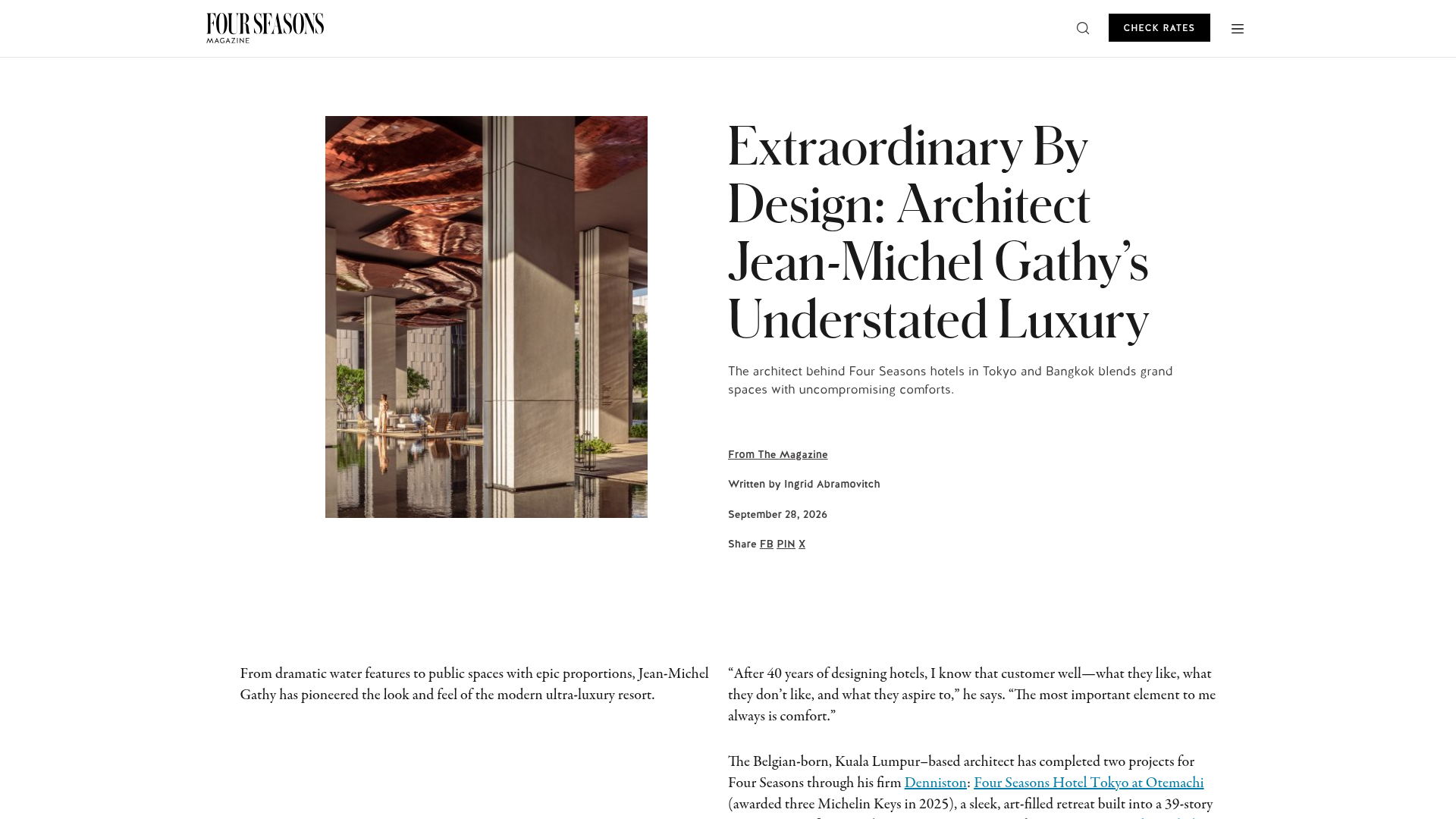
Architect Jean-Michel Gathy standing by a reflecting pond at Four Seasons Hotel Tokyo at Otemachi
Jean-Michel Gathy, the Belgian-born, Kuala Lumpur-based architect behind Denniston, continues to shape the landscape of ultra-luxury hospitality with his distinctive vision. His firm has completed two significant projects for Four Seasons: the Four Seasons Hotel Tokyo at Otemachi and the Four Seasons Hotel Bangkok at Chao Phraya River. Both properties have garnered considerable acclaim, with the Tokyo outpost earning three Michelin Keys in 2025, and the Bangkok hotel securing the No. 2 position on the World’s 50 Best Hotels list in 2025.
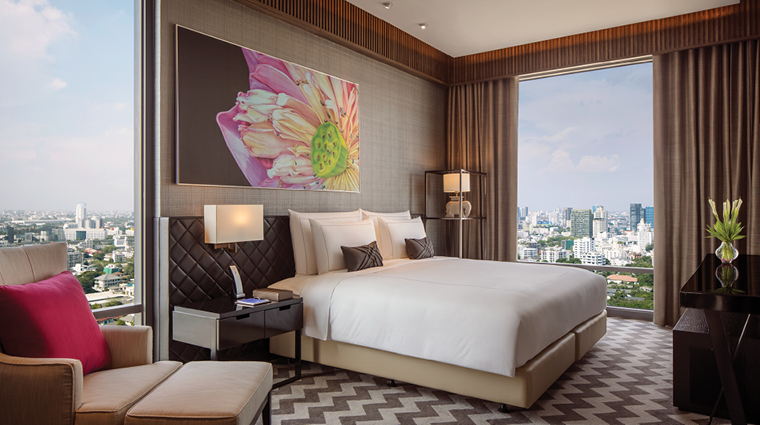
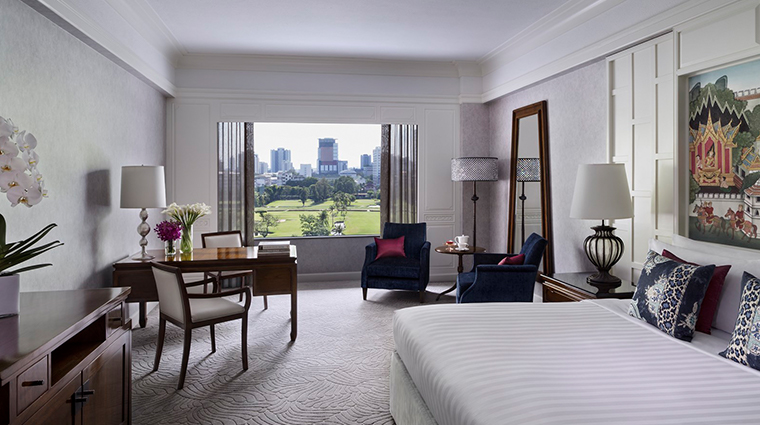
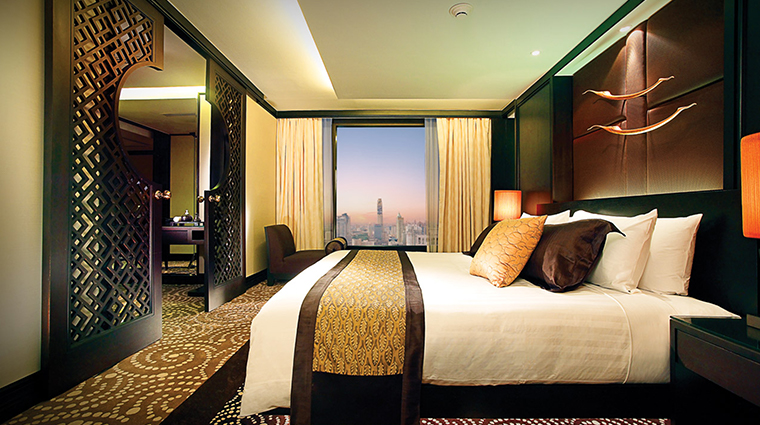
Ingrid Abramovitch of Four Seasons Magazine reports that Gathy is widely recognised for pioneering the aesthetic of the modern ultra-luxury resort, characterised by 'dramatic water features' and 'public spaces with epic proportions.' The architect himself, after '40 years of designing hotels,' states that he deeply understands the discerning client's preferences, emphasising that 'The most important element to me always is comfort.' Abramovitch notes that Gathy’s approach ensures guest rooms maintain a soothing ambiance through 'soft textures like linen and leather' and furnishings that 'whisper rather than shout,' reflecting his preference for understated luxury over overt ostentation.
The piece in Four Seasons Magazine highlights Gathy's ongoing collaborations with the brand, detailing three additional Four Seasons projects in development: a property in Shanghai's former French Concession, a resort in China’s historic city of Xi’an, and a beach resort in the UAE's Ras al-Khaimah emirate. Abramovitch describes how Gathy frequently imbues his projects with art, often of his 'own conception,' yet cultivates a 'casual chic' rather than a 'tuxedo polish' aesthetic, particularly in private guest spaces.
Abramovitch further elaborates on Gathy's inspirations, noting the significant influence of Geoffrey Bawa, the Sri Lankan architect whose work, blending modernist principles with local materials and indigenous culture, Gathy considers 'the master of tropical resort design.' Gathy particularly admires Bawa’s 'architecture based on freestanding pavilions.' The article also reveals a personal detail: Gathy's affinity for the Italian luxury brand Brunello Cucinelli, of which he owns over 75 cashmere sweaters, frequently in shades of blue. He also finds inspiration in everyday objects, describing a lamp in his living room as his 'favourite piece' because 'it generates a feeling of warmth, happiness, and peace.'
A signature element in Gathy's designs is the integration of water features. Ingrid Abramovitch observes that 'a hotel is not complete without water features mirroring the sky by day and reflecting the room’s lighting and mirrors by night.' At the Four Seasons Hotel Tokyo at Otemachi, this philosophy is exemplified by a reflecting pond situated in the 39th-floor lobby, greeting guests directly upon arrival from the elevators before they encounter the city panorama. For the Four Seasons Hotel Bangkok, Gathy selected Thai raw silk for the guest rooms, sourcing materials from suppliers such as Jim Thompson Fabrics, and basing the hotel's palette on the colours of the Thai national flag (marine blue, red, white) and native orchid hues.
Our take: Jean-Michel Gathy’s enduring partnership with Four Seasons underscores a shared commitment to a refined, contextually rich luxury. His work consistently demonstrates that true opulence lies not in overt display, but in a meticulous curation of space, material, and sensory experience. The inclusion of bespoke water features and carefully selected natural textiles speaks to a profound understanding of how environment shapes guest wellbeing, aligning perfectly with The Sanctuary's ethos of considered design and understated elegance.
Source : Four Seasons Magazine
Partager cet article