Analyses · —· (English original)
Hamptons Hotels & The Status Playbook
Luxury hospitality in the Hamptons isn't about amenities or escapism; it's a finely-tuned status game. We dissect why some properties flourish while others struggle to attract the East End's discerning clientele.
Courtesy of —
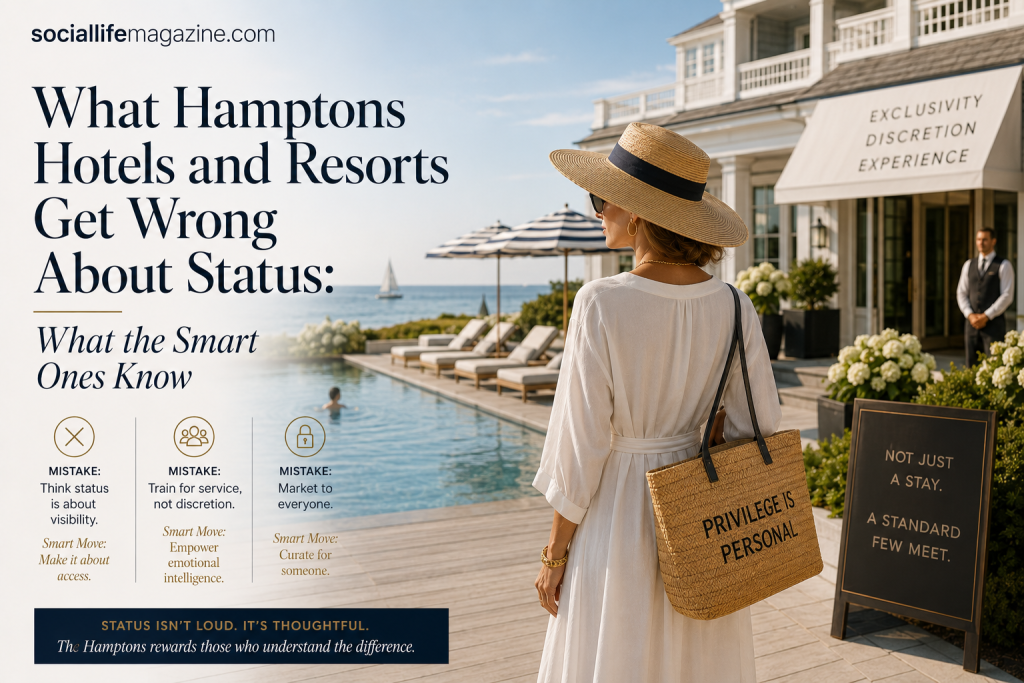
This week, Social Life Magazine offered a trenchant analysis of luxury hotel marketing in the Hamptons, asserting that success hinges on understanding local status dynamics. The publication notes a stark contrast: two hotels with similar offerings, advertising, and locations, yet one consistently sells out by March, while the other resorts to discounting shoulder-season inventory through July.
The crucial difference, according to Social Life Magazine, isn't the pool, the beach, or even the promise of an 'escape.' It's a fundamental grasp of the market. The Hamptons, the article argues, operates as a status market, not merely a travel destination. Guests paying thousands per night are acquiring a position within a social field, a signal to their peers. Effective marketing, therefore, must speak directly to this underlying status imperative.
The magazine draws upon the work of philosopher and cultural critic Camille Paglia, whose theories on human status drives inform its perspective. Social Life Magazine posits that understanding whether a hotel caters to a 'male drive toward conquest, accumulation, and public dominance' or a 'female drive toward curation, refinement, and aesthetic gatekeeping' is key to outperforming competitors. These drives are, per the publication, 'operating at full volume in every luxury transaction on the East End from Memorial Day to Labor Day.'
A Hamptons hotel, Social Life Magazine contends, is less a place to sleep and more an 'arena where status gets performed, confirmed, and transacted.' This phenomenon is particularly concentrated on the East End, where economic, cultural, and social capital converge within a compact geography during the summer season. A guest's hotel choice becomes a multifaceted statement within this context.
The very address of a Hamptons property functions as a status claim. Montauk, for instance, signals 'edgy and salt-sprayed cultural authority,' while Bridgehampton conveys 'old money adjacency' and Southampton denotes 'old-line social establishment.' Hotels that ignore these localized status dialects, Social Life Magazine warns, are effectively 'speaking into the void.'
The publication further elaborates on the 'male status drive' in hospitality, manifesting through 'conquest signals' like property scale, address exclusivity, reservation difficulty, and physical dominance. These are not amenities but 'status declarations.' Hotels like Gurney’s Montauk successfully leverage their 'cliff-top acreage above the Atlantic' to communicate scale and dominance before guests even consider a room.
Our take: Social Life Magazine hits the nail on the head. The Hamptons market demands a hyper-specific approach. Generic luxury marketing falls flat because it misinterprets the fundamental transaction. The true luxury here isn't comfort; it's affirmation. Brands that conflate the two will always struggle against those that understand their guests are buying into a narrative, not just a property. The prestige of an address or the difficulty of a booking are not incidental inconveniences, but central to the perceived value proposition. This is a crucial distinction for developers and marketers entering any high-net-worth, status-driven market.
Source : Social Life Magazine
Partager cet article