News · —
What is driving the global luxury hotel boom?
Luxury hotel growth is being fuelled by rising wealth, experience-led travel and limited supply, but profitability remains the key challenge., T&T - Poll 50 - Travel research and planning.
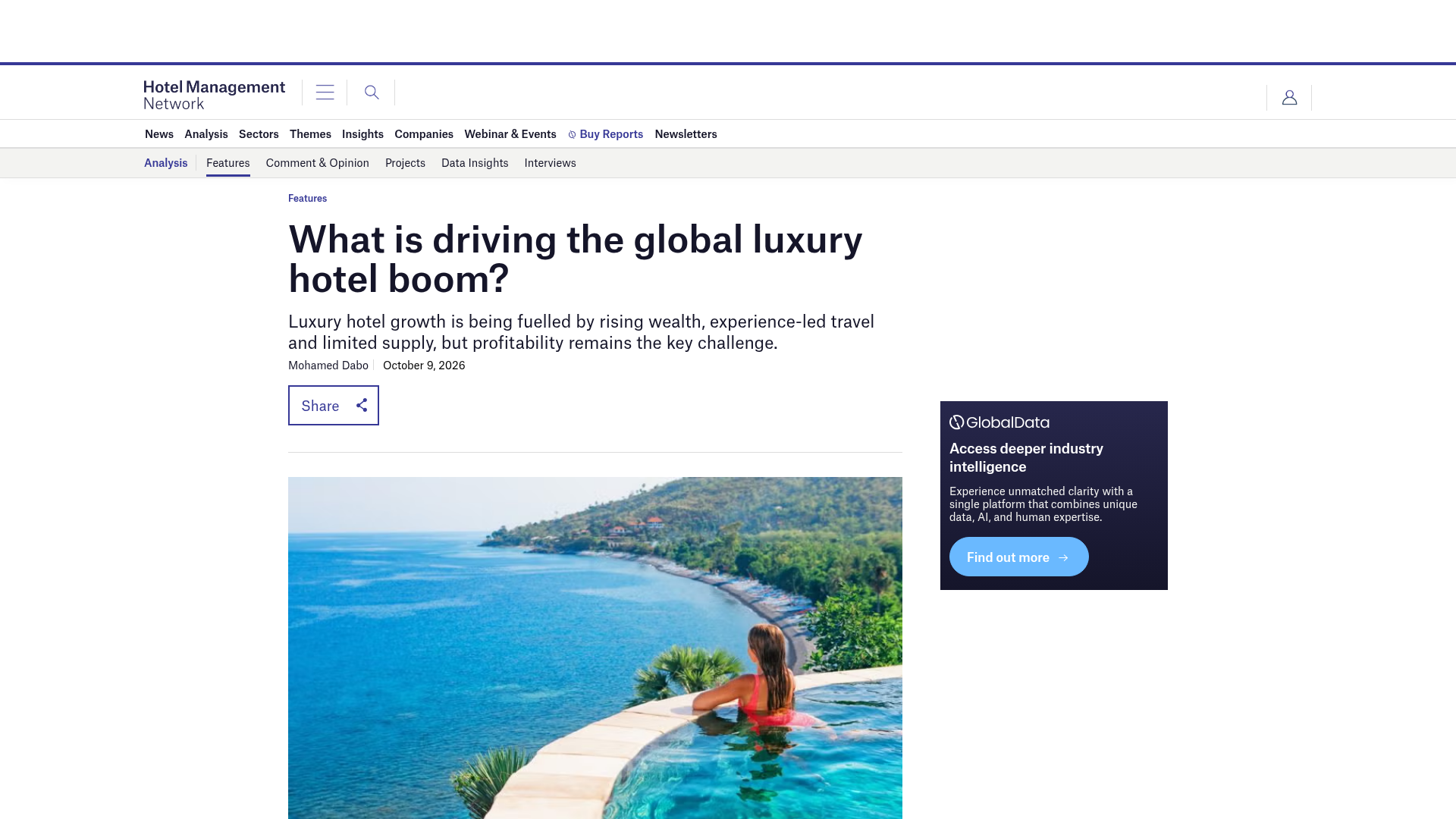
What is driving the global luxury hotel boom?
[Skip to site menu](https://www.hotelmanagement-network.com/features/what-is-driving-the-global-luxury-hotel-boom/#menu) [Skip to page content](https://www.hotelmanagement-network.com/features/what-is-driving-the-global-luxury-hotel-boom/#page-content)
Owners must balance premium guest spending against the higher costs of luxury hospitality. / Credit: Denis Moskvinov via Shutterstock
Growing wealth, demand for distinctive experiences and constrained supply are supporting luxury hotel growth. For owners and operators, the challenge is turning premium spending into sustainable profit.
Luxury hospitality is growing faster than the wider hotel market as an expanding affluent customer base seeks stays built around privacy, culture, wellbeing and personal service.

Combine business intelligence and editorial excellence to reach engaged professionals across 36 leading media platforms.
[Find out more](https://www.globaldatamarketingsolutions.com/)
McKinsey reports that the luxury hotel market grew by nearly 6% between 2023 and 2025, compared with roughly 3.5% for hotels overall. This points to stronger growth at the top end, although performance varies between properties and destinations.
T&T - Poll 50 - Travel research and planning
For hotel owners, developers and operators, the opportunity extends beyond higher room rates. Guests may pay more for space, personal attention and experiences that are difficult to find elsewhere.
Delivering those benefits requires investment in property, people and local partnerships. Understanding the luxury hotel boom therefore means examining both changing guest preferences and the economics of serving them.
The expansion of the world’s ultra-wealthy population is enlarging the potential customer base for high-end hospitality.
Knight Frank estimates that the number of ultra-high-net-worth individuals — people with net worth exceeding US$30 million — increased from 551,435 in 2021 to 713,626 in 2026, a rise of approximately 29%. Growing wealth does not automatically translate into hotel bookings, but it expands the pool of consumers with substantial spending power.
At the same time, luxury hotel supply can be difficult to expand in sought-after locations. JLL identifies high construction costs and barriers to entry in prime markets as constraints on ultra-luxury development. Its 2026 Global Hotel Investment Outlook puts annual growth in ultra-luxury room supply at 2.3% between 2015 and 2025.
Source : Hotel Management Network
Share this story